
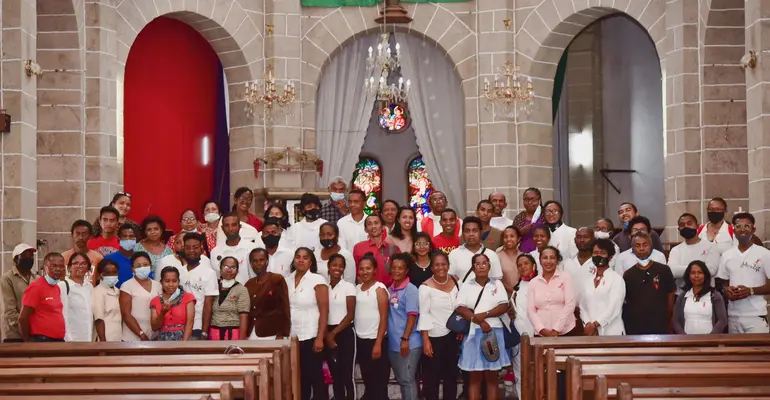
Listen, raise awareness, train, accompany, and send forth. Five verbs that tell the story of an experience, but above all, help us understand and live out a mission: walking with young people. Walking with young people means taking their realities and deepest aspirations seriously and empowering them to become the change they wish to see.
In Madagascar, this mission takes on particular significance in the face of the complex realities confronting young people, including difficulties in accessing reliable health and educational facilities and the limited opportunities afforded to them in society. They are often labelled immature and irresponsible.

This approach gradually took shape at Centre Arrupe Madagascar (CA-MDG), beginning with the Education à la Vie et à l’Amour (EVA) (Education for Life and Love) programme and later incorporating the AJAN HIV and AIDS Prevention Programme for the Youth (AHAPPY). EVA is a holistic approach initiated by la Conférence des Evêques de Madagascar-(CEM) (the Episcopal Conference of Madagascar) in 2008 to complement the national reproductive health programme introduced in public schools and promoted daily through mass media. The Centre promotes this programme as part of its contribution to reducing risky behaviours related to sexually transmitted infections (STIs) and HIV&AIDS.
From the beginning, through its various activities, CA-MDG as one of the AJAN field Centres in Madagascar has remained committed to one conviction: sustainable solutions to the challenges facing Malagasy society must be rooted in an understanding of people’s lived realities and the Centre’s continued involvement as a support structure.
Therefore, before raising awareness, training, or accompanying people, we must first listen in order to understand their lived realities rather than those we imagine.
Listen: Starting with Lived Realities
Before proposing a solution to a problem, we must understand what people are actually experiencing. Listening is therefore the first step in this approach.
CA-MDG’s experience developed in response to a complex reality in which young people face multiple challenges: economic difficulties, lack of information, social pressure, changes associated with adolescence, et the rapid evolution of their technological and social environments. In this context, HIV and STI prevention needed to take into account the people being reached rather than simply transmitting medical information.
Drawing on its experience in youth education, the Programme Santé et Famille (PSF) (Health and Family Programme), in collaboration with Catholic Relief Services since 2006, had contributed to developing the EVA programme. This programme proposed a broader approach, initially addressing knowledge of HIV and STIs, their modes of transmission, and prevention. It also explored communication, respect for life, values, adolescents’ environments, and an understanding of “true love.”
The EVA programme is based on understanding the person as a whole. Young people are therefore listened to in order to understand them better, taking into account their questions, doubts, emotions, values, aspirations, and search for meaning. Through these exchanges, the importance of topics such as self-awareness, self-esteem, leadership, relationships with others, and sexuality management gradually emerged.

Listening goes beyond direct conversations with young people. It also involves research, which helps document their lived realities, understand their causes, and guide appropriate responses. Research conducted by CA-MDG enables the Centre to listen to target populations, assess their experiences, and develop corresponding solutions.
In 2016, a study examined factors limiting the effectiveness of HIV care in four regions of Madagascar with significant HIV-related needs. This retrospective and descriptive cross-sectional study was conducted from May to July in six referral hospitals across four regions: Analamanga, South-West, Diana, and Boeny. It used two approaches: a quantitative study involving 338 people living with HIV (PLHIV) and seven referring physicians, and a qualitative approach involving focus groups with 111 participants, including healthcare workers, health-sector stakeholders, and people living with HIV. Following the research, recommendations were made to healthcare personnel, government and religious leaders, and the target population.
Raise Awareness: Opening Paths to Greater Understanding
At CA-MDG, awareness-raising activities have taken many forms, including conferences and debates, group activities, exhibitions, film screenings, interventions in schools and parishes, and activities during major gatherings.

Every Thursday, the PSF team at CA-MDG hosts the AHAPPY programme on Radio Don Bosco (RDB), exploring topics related to family, health, relationships, young people, and HIV/AIDS. The fourth Thursday of each month becomes a special opportunity for young people to move beyond being mere recipients of messages. They become the programme’s presenters and begin to carry the message themselves as they interact with listeners through text messages and live calls.
Preparing for the radio programme has enabled these young people to develop their public-speaking skills and experience a sense of pride that strengthens their self-esteem. The specific topics also encourage them to conduct research and reflect on their choices, values, and futures, in line with Universal Apostolic Preference 4.

The testimony of Miharisoa, a young woman trained through AHAPPY who participates in the broadcasts, illustrates this transformation:
“The training I received gave me new knowledge. This knowledge helped me change the way I see life. I am very happy because I can share with young people across the island through the RDB programme. The radio sessions have also helped me become less shy and improve the way I communicate and speak.”
Train: Moving from Knowledge to the Ability to Act
Turning awareness into meaningful action requires knowledge and practical understanding. As a centre dedicated to training and research, CA-MDG places strong emphasis on equipping people with the knowledge and skills needed to make a difference. Each training session is carefully structured around specific objectives and themes, targeting primarily young people involved in Church-based and civil society organisations, including associations and non-governmental organisations (NGOs). Through these initiatives, CA-MDG seeks to strengthen their capacity to translate awareness into informed action within their communities.

Between 2013 and 2017, with an HIV prevalence rate of 0.4%, Madagascar was considered a low-prevalence country. PSF therefore set itself the overall objective of helping maintain this rate. Its training objectives focused on prevention: reducing risky behaviours, promoting parental education, conducting awareness sessions on women’s health, facilitating screening, and supporting the medical, psychosocial, and spiritual care of people living with HIV in collaboration with physicians from the Association of Catholic Doctors of Madagascar (AMCM).
Through the AHAPPY program, youth leaders are trained to facilitate local clubs and drive community activities within their respective organizations and institutions. Rather than focusing solely on personal growth, the program prepares participants to serve as peer educators, leaders, and coaches, shifting the traditional paradigm of youth as passive beneficiaries into active community resources.
Simultaneously, the JYSEA initiative supports young entrepreneurs in developing social enterprises that deliver both economic self-sufficiency and positive community impact. In Toliara, southern Madagascar, entrepreneur Rafamantanantsoa Antonio launched SARABIO, a small enterprise utilizing innovative waste management techniques. Today, the business is fully operational, providing him with a reliable livelihood while addressing local environmental challenges.
Ultimately, these training initiatives aim to transform participants into active agents of change within their own lives and broader communities.
Importance of Accompanying: Ensuring No One Is Left Alone After Training
Training can open a door, but sustained progress requires ongoing accompaniment. Following each AHAPPY session, participants create action plans outlining their planned community activities, with CA-MDG providing essential follow-up, this is just as important as delivering the training itself. The aim is to give young people time to share their experiences and revisit sections of the manual for deeper understanding. This follow-up is essential because it transforms a one-off training session into a sustained process
To further strengthen local engagement, the center achieved a major milestone by translating the AHAPPY manual from English into Malagasy. Similarly, within the EVA program, young participants co-facilitate activities alongside educators so that they could gradually take over. Having received support, they are, in turn, called to support someone else. This accompaniment goes beyond skill building, encouraging the youth to ask not just what they know or do, but how they can put their gifts at the service of others and who they are called to become.

During this accompaniment young people are encouraged to reflect on questions such as: “How can I put what I have received at the service of others?” and “What kind of person am I called to become?” rather than focusing only on “What do I know?” or “What should I do?”
Sending Forth: Trusting Others to Multiply the Impact
The final verb, send forth, gives purpose to all the preceding actions. Through listening, awareness-raising, training, and accompaniment, people are equipped to share what they have learned with others. This is at the heart of AHAPPY, which empowers young people to become peer educators, leaders, and facilitators of change. Beyond learning from the AHAPPY manual, they are encouraged to establish or facilitate clubs and organise activities in their communities, sharing their knowledge and inspiring their peers to take action.

At CA-MDG, this transformation is already visible. Young people who have received training have participated in AJAN’s video and writing competitions, finding the courage to speak out about issues affecting them and their communities. Their voices reach beyond their personal experiences, raising awareness and encouraging others to act. One example is Bebeto, whose video on drug use, “STOP DRUGS,” won first place in the 2024 AJAN AHAPPY Storytelling Youth Contest.
The process thus becomes circular: we listen to young people’s realities so that we can engage with them more effectively; we raise awareness to encourage understanding; we train them to develop their capacities; we accompany them to strengthen their journey; and then we send them forth to reach others in turn. This dynamic also transforms how we understand impact.
By sending them forth, we place our trust in others. It means accepting that we should not be the sole bearers of the mission but should allow others to bring it to life through their own words, talents, initiatives, and communities. Perhaps this is where the mission bears its greatest fruit: when someone who has been accompanied becomes capable of accompanying others, raising awareness, and nurturing new initiatives around them.
Ultimately, these five verbs come together in a shared vision of mission rooted in dignity, hope, accompaniment, and service. Listening reflects the first Universal Apostolic Preference: walking with the poor and excluded and recognising their dignity. Raising awareness and training respond to the call to accompany young people as they build a hope-filled future, while accompaniment creates space for discernment and personal growth. Sending forth completes this journey by fostering collaboration and empowering people to contribute to the transformation of their own communities.
In Madagascar, this mission remains a journey in progress, shaped by successes, limitations, and ongoing questions. Yet, through it all, one conviction remains clear: mission is not simply about doing things for others, but walking with them, trusting in their potential, and empowering them to become missionaries themselves.
Read Also: https://ajan.africa/ajan-director-visits-centre-social-arrupe-madagascar/
Par, Randrianarijaona Norovoahangy Gilbertine
Programme Officer, Health and Family
Centre Arrupe, Madagascar

 Français
 English
 Português
Comments are closed.