
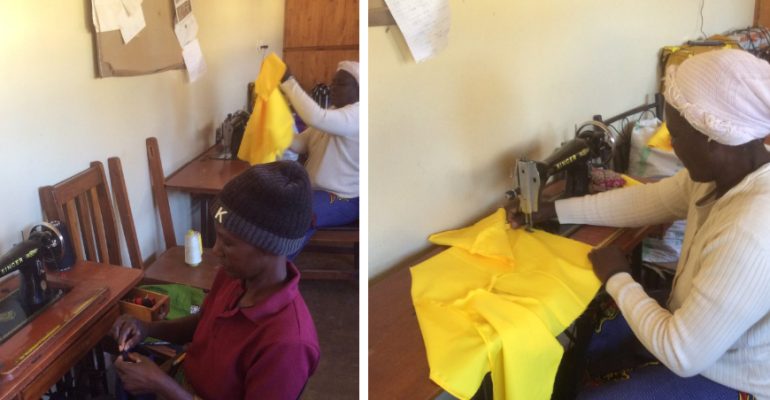
Chikuni Home Based Care (CHBC), Southern Province, Zambia —In the rural communities surrounding Chikuni Mission in Zambia’s Southern Province, a new opportunity is taking shape for women and girls who have traditionally had limited opportunities to earn an income.
Through the Building Resilience among Women and Young Girls in Africa (BRWGA) project, the Chikuni Home Based Care Project is supporting 20 girls and women to develop practical, self-sustaining livelihoods through tailoring and gardening.The initiative aims to equip participants with the skills, tools and business knowledge they need to generate income and gradually become self-reliant.
The project that kicked off in April 2026 and is being implemented in a rural community where small-scale agriculture and gardening are important sources of livelihood. However, limited access to water and markets remains a challenge for people seeking to turn their skills and products into sustainable income.
Turning Skills into Opportunity
For the 20 participating women and girls, the project is already creating visible change.
Tailoring activities are now underway, with training and practical work focused on making school uniforms for pupils in local community schools. Tailoring materials have been purchased, enabling participants to put their newly acquired skills into practice. Rather than receiving support without a pathway to sustainability, the participants are being prepared to run their own small businesses.


Weekly support and monthly review meetings with the project officer are helping them strengthen their skills and remain focused on building sustainable livelihoods. Gardening activities are also beginning to take shape. Five gardens are being fenced and prepared following the completion of the harvest season. Local materials are being used to construct fences, an important adaptation in an area where domestic animals roam freely after harvest. The gardens are also promoting the effective and climate-smart use of land and water resources.
Learning the Business Behind the Business
The project recognises that practical skills alone are not enough to create sustainable livelihoods. To strengthen the participants’ entrepreneurial capacity, all 20 women and girls took part in a one-day business incubator boot camp.
The training covered a broad range of business skills, including business planning, start-up, operations, management, sales, marketing, expansion and financial management. This approach is designed to ensure that participants understand not only how to make a product, but also how to turn that product or service into a viable small business.
A New Sense of Possibility
The impact is already visible beyond the technical skills being acquired. The women and girls have developed a visible sense of happiness from having meaningful activities that can contribute to improving their lives.
For some participants, this represents a significant shift from spending their time primarily on household chores that do not generate income. Their growing ability to make school uniforms and participate in gardening is giving them practical skills and a stronger sense of purpose. The project currently has 20 direct beneficiaries, while an estimated 150 family members are expected to benefit indirectly over the lifetime of the project.

The women and girls are being trained not to depend on repeated injections of external funding, but to develop businesses capable of sustaining themselves. Once they become established, the beneficiaries are expected to mentor a new cohort of girls and women.
This creates a model of multiplication: women who have themselves overcome disadvantage can become role models and mentors for others who are still struggling to find opportunities. The long-term vision is therefore not simply to create 20 small businesses. It is to create a growing network of rural women entrepreneurs who can empower other women.
Planting Seeds for the Future
In Chikuni, the BRWGA project is demonstrating that empowerment can begin with practical, locally appropriate opportunities. A sewing machine, a piece of land, a garden, business knowledge and the confidence to use these resources can become the foundation for a more sustainable future.
The journey is still at an early stage. The project expects the next phase to bring further evidence of impact as school uniforms are sold, profits are generated and participants begin using income to support education and household needs. For now, the women and girls of Chikuni are learning, producing and building. And with every uniform sewn and every garden prepared, they are taking another step toward self-reliance.
By, Fr. Gregory Mulobela SJ.,
CHBC, Director.

 English
  Français
  Português
Comments are closed.