
Future of the African Child Flows Through Clean Water and Dignified Life
In 2026, we commemorate 50 years since students in Soweto stood up and protested poor educational conditions and the imposition of Afrikaans as the language of instruction. That peaceful civic expression and defence of human rights culminated in the tragic massacre on 16 June 1976. This year also marks 35 years since the Organisation of African Unity, now the African Union, designated 16 June as the Day of the African Child to promote and protect children’s rights across Africa. Today, injustices against children and limited access to basic needs are still a reality. What have we learned?
On this special Day of the African Child 2026, the global community is invited to confront a fundamental truth: the future of the African child is inextricably linked to access to clean water, sanitation, and hygiene. As Scripture reminds us, “Let the little children come to me” (Mt. 19:14), every child’s right to life, health, dignity, and hope must be urgently protected.
This year’s theme, “Ensuring Universal Access to Water, Sanitation and Hygiene for Every Child in Africa,” is more than a policy priority; it is a moral and Gospel imperative. WASH services are essential to human dignity and to the fullness of life promised by Christ: “I came that they may have life and have it abundantly” (Jn. 10:10). As an African proverb teaches, “Water is life, and life is water.”
For the African Jesuit AIDS Network (AJAN) and its partner institutions, this mission is deeply personal. Guided by the Jesuit Universal Apostolic Preference to journey with youth and accompany young people in creating a hope-filled future, AJAN refuses to stand by as poverty, climate change, conflict, disease, and exclusion diminish the next generation’s promise. Pope Francis reminds young people in Christus Vivit that “Christ is alive! He is our hope” and that “he wants you to be alive” (Christus Vivit, no. 1). In Dilexi Te, Pope Leo XIV also recalls that Christ says to his followers, the poor and powerless, “I have loved you” (Rev. 3:9; Dilexi Te, no. 3). This hope becomes concrete when children are protected and educated, their dignity promoted, and they are given access to the basic resources they need to flourish.
The Silent Shield: WASH and the Fight Against HIV.
When we speak about the fight against HIV and AIDS, attention often centres on antiretroviral therapy and medical interventions. Yet medicine requires a foundation of health to be effective. For children and adolescents living with HIV, clean water and proper sanitation are a silent but powerful shield. “Whoever gives even a cup of cold water to one of these little ones” will not lose their reward (Mt.10:42). In this light, every borehole, latrine, handwashing station, and hygiene lesson becomes an act of mercy and justice.
Without safe water, vulnerable children are at risk of opportunistic infections that weaken immunity, disrupt adherence to treatment, and compromise nutrition. By prioritising WASH infrastructure, AJAN safeguards dignity and strengthens resilience, ensuring that a medical diagnosis does not determine a child’s destiny. As an African proverb says, “A child who is not embraced by the village will burn it down to feel its warmth.”
Malawi: Cultivating Hope on the Frontlines of Climate Change.
In Malawi, where the heartbeat of the economy is tied directly to agriculture, climate change is no longer a distant warning; it is a daily reality. Erratic rainfall, punishing droughts, and dwindling crop yields place severe pressure on rural families. Children often bear the heaviest burden, sometimes leaving classrooms to walk long distances in search of water. Scripture names this thirst with compassion: “The poor and needy seek water, and there is none… I the Lord will answer them” (Isaiah 41:17). Therefore, the work of providing water is also participation in God’s response to the cry of the vulnerable, including the children.
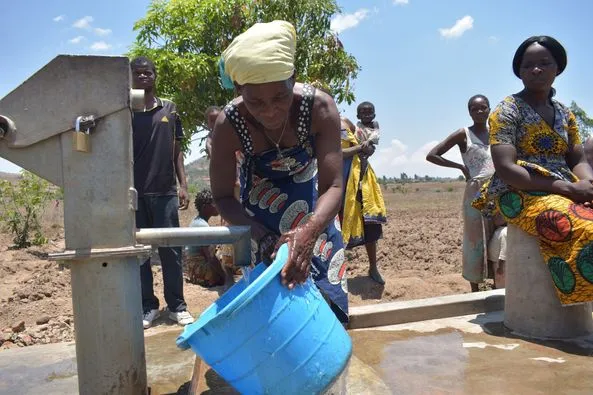
In 2023 With funding JesuitenWeltweit Deutschland, JCED has supported Mchenga community in Phalombe with a new borehole and rehabilitated three boreholes in Chiradzulu which were damaged following the Cyclone Freddy. Credits: the Jesuit Centre for Ecology and Development (JCED).
In the face of this ecological crisis, the Jesuit Centre for Ecology and Development (JCED) is responding with a holistic approach inspired by Pope Francis’s Laudato Si’. Pope Francis teaches that “everything is connected” (Laudato Si’, no. 91) and that concern for the environment must be joined with love for our fellow human beings and a commitment to solving social problems. Through the Tasintha Mlimi Project, JCED demonstrates that environmental sustainability and human development are inseparable.
JCED has successfully delivered safe, reliable water to the vulnerable villages of Njalale, Dawa, and Thipa. At the same time, it is installing a reticulated, solar-powered water system at Katayanthona Primary School. This innovation does more than quench students’ thirst; it transforms the school into a sanctuary of learning, reduces the burden of chores on young children, and strengthens community resilience to climate shocks. As the African proverb says, “If you want to go fast, go alone; if you want to go far, go together.” JCED’s work goes far because it places communities, schools, families, and creation on the same journey of hope.


Image Courtesy: Jesuit Centre for Ecology and Development (JCED).
A multimedia feature accompanying this message highlights how people and communities are turning awareness into daily practices that promote health, dignity, and the environment. 📷 compelling eight-minute documentary on the Tasintha Mlimi project.
Madagascar: Building Resilience on an Island Frontier.
The challenges of water access and environmental sustainability are not confined to the mainland. Across the Indian Ocean, Madagascar faces complex ecological realities that directly affect children, families, and vulnerable communities. The Book of Genesis reminds humanity that creation is entrusted to our care (Gn. 2:15). Therefore, protecting land, water, and biodiversity is also a way of protecting the poor.
Madagascar is regularly exposed to cyclones, droughts, floods, and erosion, alongside declining environmental resilience. These compounding crises damage infrastructure, disrupt essential services, and compromise access to clean water and sanitation, thereby increasing health risks for children already facing socio-economic vulnerability.

In response to these fragile realities, the Centre Arrupe Madagascar (CA-MDG) has embraced a bold vision: to foster “a more just society, a more viable world, and a more liveable environment.” Inspired by faith, committed to justice, and guided by the social and ecological priorities of the Jesuit Province of Madagascar, the Centre promotes sustainable solutions for the poorest and most vulnerable. Pope Francis’s call in Laudato Si’ to hear both “the cry of the earth and the cry of the poor” (Laudato Si’, no. 49) finds practical expression in this mission.
Through its Environment and Sustainable Development Programme and the Life and Environmental Education project, CA-MDG promotes environmental stewardship, equitable access to natural resources, and sustainable development. The programme reflects a simple truth: protecting creation and promoting human dignity go hand in hand.
The DRC: A Lifeline Amidst the Chaos of Conflict.
If water is necessary in times of peace, it becomes a matter of immediate survival in times of war. In the eastern Democratic Republic of the Congo (DRC), escalating conflict has destroyed infrastructure and left displaced families exposed. The image of the Good Samaritan in the Gospel (Lk. 10:25–37) challenges every community of faith to stop, see, and respond to suffering—not from a distance, but with practical compassion.
Following severe disruptions caused by intensified fighting, hundreds of thousands of residents were left without access to clean water, electricity, or sanitation. In response, UNICEF and partners have delivered lifesaving clean water to roughly 700,000 people in Goma each day, including more than 364,000 children.
In a country where only 43 per cent of the population has access to basic water services and only 15 per cent to basic sanitation, restoring these services is not merely a logistical task; it is an emergency triage for human survival. In this regard, Pope Francis warns against a culture of indifference and calls humanity to recognise that we are “all in the same boat,” where one person’s problems are the problems of all (Fratelli Tutti, no. 32). In the DRC, that call becomes concrete in every act that restores water, sanitation, safety, and dignity.

Alongside emergency responses to water and sanitation challenges in the DRC, AJAN’s field centre, Centre Maisha in Kisangani, is driving long-term behavioural change through community education and youth engagement. Recognising that access to clean water must be paired with proper hygiene, the Centre regularly runs awareness campaigns in schools and communities on sanitation, environmental cleanliness, disease prevention, and climate change. Through these initiatives, students adopt healthy hygiene habits, care for their surroundings, and become ambassadors of environmental stewardship. The Centre believes in the call of God: “Train children in the right way, and when old, they will not stray” (Proverbs 22:6). Centre Maisha complements these awareness activities with practical support by providing sanitation materials and promoting clean school environments, helping to reduce the spread of waterborne and hygiene-related diseases.
Burundi: Healing Communities Displaced by Disaster
The echo of the DRC’s crisis is clearly felt in neighbouring Burundi, where Service Yezu Mwiza (SYM) works at the intersection of forced displacement, poverty, and public health. In such contexts, the Church’s mission is to stand close to those whose lives have been uprooted, remembering the words of the Vatican II Council: “The joys and the hopes, the griefs and the anxieties of the men of this age, … are the joys and hopes, the griefs and anxieties of the followers of Christ” (Gaudium et Spes, no. 1), as well as the word of Christ: “I was a stranger, and you welcomed me” (Mt. 25:35).
When conflict or flooding—such as the recent rise in the Rivière Rusizi (Rusizi River) in Gatumba—forces families into overcrowded host communities, the strain on water resources increases sharply. This directly fuels, among other consequences, chronic child malnutrition, disruption of education and the spread of infectious diseases.
To address this, SYM balances immediate emergency relief with a holistic public health approach. Beyond targeting waterborne illnesses, SYM recognises that adequate sanitation and clean environments are essential for preventing and managing broader infectious diseases, including tuberculosis (TB) and leprosy.

Through community outreach, hygiene education, and support for healthier living conditions, SYM protects the dignity and well-being of vulnerable families. Access to clean water strengthens patients’ immunity and supports treatment and recovery for those affected by tuberculosis and leprosy. As an African proverb reminds us, “When spider webs unite, they can tie up a lion.”
A perspective for Tomorrow.
The lived realities in Malawi, Madagascar, the DR Congo, and Burundi reveal an undeniable truth: water is never merely about hydration. It is the cornerstone of education, the bedrock of healthcare, the foundation of environmental justice, and the prerequisite for human dignity. Pope Francis teaches that “access to safe drinkable water is a basic and universal human right,” because it is essential for survival and for the exercise of other human rights (Laudato Si’, no. 30). Defending water is therefore defending life itself.
As we honour the Day of the African Child, AJAN and its partners are doing more than reflecting on the challenges that remain. They are renewing a sacred commitment to journey alongside young people, families, and marginalised groups. The prophet Amos calls for justice to “roll down like waters, and righteousness like an ever-flowing stream” (Amos 5:24). That justice must flow through schools, clinics, villages, displacement camps, and every home where a child waits for the chance to live with dignity.
Investing in Africa’s children today by securing universal access to clean water, sanitation, and hygiene is one of the most effective ways to build a healthier, more equitable, and hope-filled continent for generations to come. The future of the African child will not be secured by words alone, but by wells that work, schools that protect, communities that care, and policies that put children’s well-being and the common good first. As the proverb says, “The child who is loved has many names.” This means the child is never anonymous; they are recognised, protected, and celebrated as bearers of hope and the future. May every African child be known by name, with dignity, health, and hope, and their well-being promoted.
Let Justice Flow Like Water.
Cognisant of the benefits of partnership and collaboration, as reflected in the saying “united we are stronger”, on this Day of the African Child, I call on all people of goodwill to move from concern to commitment. Pope Leo XIV reminds us: “If you want to cultivate peace, care for creation,” and further urges that “we must turn words and reflections into choices and actions based on responsibility, justice, and equity” (Message to COP30, 7 November 2025). Governments and policymakers must prioritise child-centred WASH investment in schools, health facilities, rural communities, and displacement settings. Faith-based institutions, schools, and communities should promote hygiene education, ecological responsibility, and practical solidarity with vulnerable families. Development partners and donors are invited to support sustainable water systems, climate-resilient infrastructure, and community-led sanitation programmes. Parents, carers, and young people can become guardians of clean water by protecting water sources, practising good hygiene, and advocating for safe environments.
Let these three questions resound in our hearts and prompt action: Where are our children? How and in what environment are they educated? Where do they receive health care, and how are they raised and protected?
If justice is to “roll down like waters”, as the Prophet Amos reminds us (Amos 5:24), then every borehole repaired, every handwashing station installed, every school protected, and every child accompanied is a step towards the healthy Africa we long to see, an Africa that cares for, protects, nourishes, and invests in its young generation at all costs. Only by doing so will the future of every African child be secured.
Fr. Ismael Matambura, SJ
Director, AJAN.

 English
  Français
  Português
Comments are closed.