
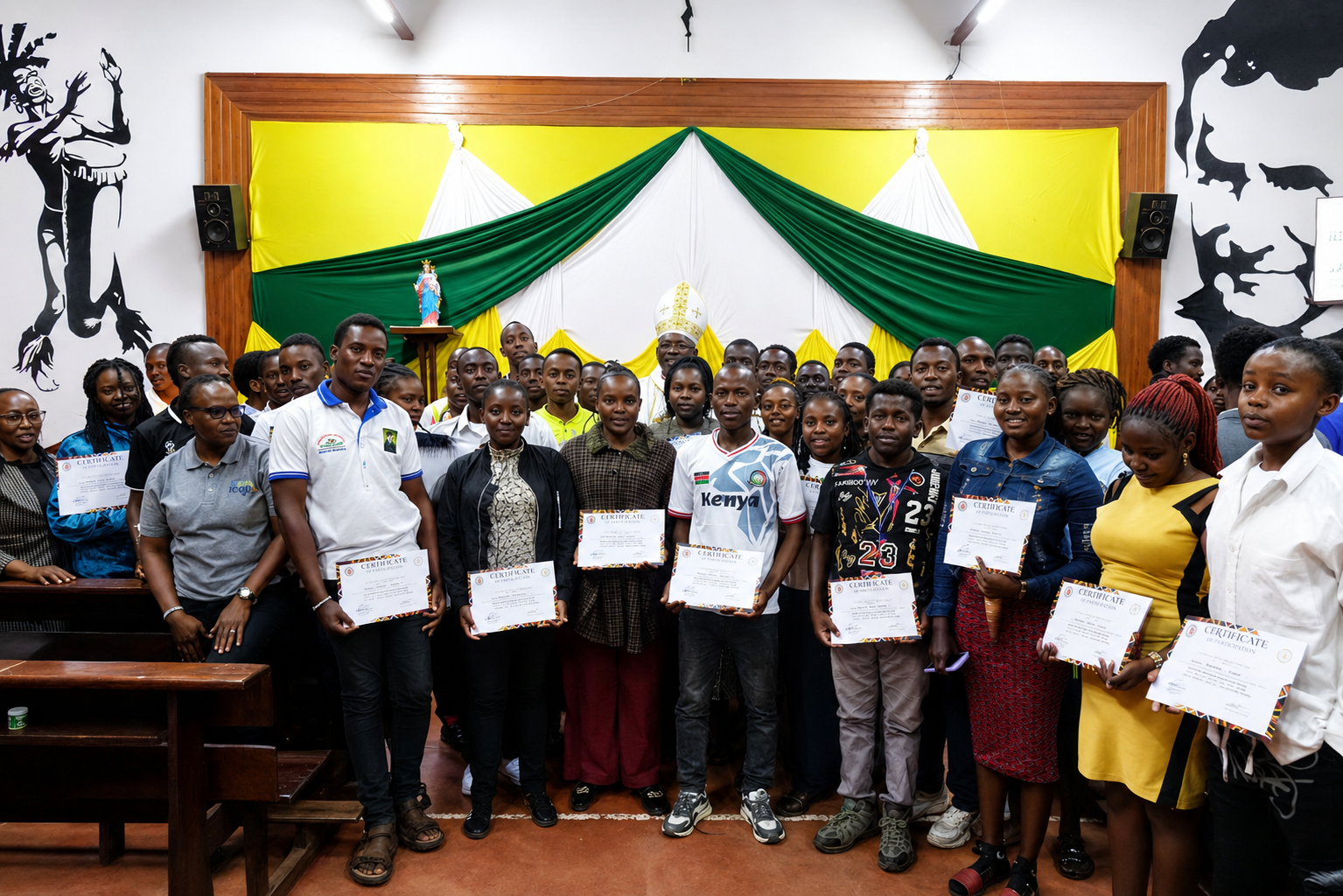
The African Jesuit AIDS Network (AJAN) undertook a 5-day AJAN HIV and AIDS Prevention Programme for the Youth (AHAPPY) Training of Trainers (ToT) for the Catholic Diocese of Embu, bringing together 35 youth leaders from 17th to 21st August 2026. The training was aimed at their integral formation equipping them with the knowledge, skills and values needed to accompany young people within their parishes and communities to live healthier lives and make responsible choices.

The training was facilitated by the AJAN team, comprising Ms. Pascalia Sergon, Acting AJAN Director; Mr. Dennis Owuoche, AJAN Communications Officer; and Ms. Lilian Waweru, Principal Chaplain, Kenya Prisons. Also present is Rev. Fr. David Njeru, Youth Chaplain for the Catholic Diocese of Embu, who is supporting the training and youth formation efforts of the Diocese.
The first day introduced participants to the first module of the AHAPPY Generation Programme, “Awakening to Myself.” The module invited participants to begin by paying attention to themselves—to understand who they are, recognize their strengths and vulnerabilities, examine their choices, and appreciate the interconnectedness of the different dimensions of their lives.

The opening session, led by Ms. Lilian Waweru, provided participants with an opportunity to introduce themselves and share their expectations for the training. Their reflections revealed a strong desire to gain practical knowledge and skills that would enable them to better understand the realities shaping the lives of young people today. Participants expressed a keen interest in learning more about HIV and AIDS transmission and prevention, developing mentorship and leadership skills, enhancing their personal and professional development, and strengthening their capacity to accompany and support young people in their communities. They also hoped the training would equip them with the tools needed to make informed decisions and become positive agents of change among their peers.
The session also created space for participants to reflect on their own experiences and the responsibility that comes with becoming trainers and mentors of others.
Understanding AJAN and the AHAPPY Pedagogy
Ms. Pascalia Sergon later introduced participants to AJAN and the AHAPPY Generation Programme, providing an overview of the network’s mission and the approach that underpins its youth formation work.


Participants were introduced to the five dimensions of the human person that form an important foundation of the AHAPPY Programme:
- Spiritual – nurturing one’s relationship with God, faith and values.
- Physical – understanding and caring for one’s body and physical well-being.
- Social – building healthy relationships and responsible engagement with others.
- Emotional – recognizing, understanding and managing one’s emotions.
- Intellectual – developing the capacity to think critically, reason, learn and make informed decisions.
The participants were encouraged to see these dimensions not as separate parts of life, but as interconnected aspects of the whole person. A decision made in one area can have consequences across the other dimensions, highlighting the importance of holistic formation.
Learning Through Story and Reflection

To deepen the day’s reflections, participants watched a film illustrating how poor decisions can affect multiple dimensions of a person’s life. The story provided an opportunity to move beyond theory and examine how choices can shape relationships, emotional well-being, physical health, spiritual life and future opportunities.The film prompted participants to reflect on their own experiences and the choices young people face in their daily lives. It also reinforced an important message of the AHAPPY approach: young people need more than information—they need spaces where they can reflect, ask questions, develop self-awareness and acquire the skills to make responsible choices.


The second day moved the participants from looking within themselves to examining the world around them through the module “This World I Live In – Be Intelligent.” They reflected on the realities that shape young people’s lives and explored HIV and AIDS, sexually transmitted infections and drug and substance abuse. Because the participants are themselves young people, many of the conversations were close to their own experiences and those of their friends and peers. They were challenged to understand that accompanying young people requires more than giving instructions. It requires listening, understanding their circumstances and creating an environment where they can ask questions and speak openly about the challenges they face.
Day three took the participants deeper into the realities of HIV and AIDS through the module “Facing a World with HIV and AIDS – Be Reasonable.” They explored vulnerability factors among young people, HIV and STI prevention, positive living, being a good Samaritan and the impact of pandemics on their world. The sessions helped the participants connect knowledge about HIV with the realities of human relationships and personal responsibility. They gained a better understanding of how young people can become vulnerable and the importance of living a virtuos life and at the same time how they can be better leaders in molding the younger generation.

They also reflected on how they could approach sensitive conversations without judgement, recognising that sometimes a young person needs someone who will listen before they need someone who will advise. For the participants, this was an important part of their formation. They were not only being prepared to pass information to others; they were being prepared to become trusted companions to their peers.
On the fourth day, the focus turned to “Knowing to Grow Myself – Be Responsible.” Participants explored skills for knowing and living with themselves and others, mentorship and effective communication. The sessions encouraged them to reflect on how they communicate and relate with others, emphasising the importance of effective listening, understanding different perspectives and building relationships based on trust.

The conversation also extended to the digital spaces that have become an important part of young people’s lives. Participants reflected on how they can use social media intentionally to develop their skills, build their personal brands and market themselves, while remaining responsible in the way they present themselves online. In a world that is rapidly embracing artificial intelligence (AI), they were encouraged to recognise the opportunities technology offers for learning, creativity, networking and personal growth, while also thinking critically about how they use these tools.


The discussions helped the young leaders see that responsibility extends beyond face-to-face relationships. It also includes how they communicate, create and represent themselves in digital spaces.
They also discovered that mentorship is not about having all the answers. It is about walking with another person, helping them reflect, listening without judgement and supporting them as they make their own responsible decisions. For young leaders who are themselves navigating college life and the rapidly changing digital world, these skills are essential as they seek to accompany their peers with authenticity, wisdom and responsibility.
The final day brought together the lessons of the week through the module “The Foundation on Which I Build My Life – Be Wise.” Participants reflected on values and principles of life, becoming virtuous people and the role of social entrepreneurship in social transformation. They then developed and presented action plans, allowing them to think about how they would translate the lessons of the training into action within their parishes communities.


Looking back on the five days, the participants had gained much more than technical knowledge. They had deepened their understanding of HIV and AIDS and its prevention, developed mentorship and communication skills, reflected on responsible decision-making and explored the importance of values in leadership. They also gained a greater appreciation of their own potential to influence the lives of other young people. The diversity of participants from different deaneries also enriched the experience. They brought different parish experiences and perspectives, yet discovered that many of the hopes and challenges of young people are shared. The training created an opportunity for them to learn from one another and strengthen a sense of shared responsibility for youth ministry within the Diocese.
The five-day journey reached its culmination during a commissioning Mass led by Bishop Peter Kimani Ndung’u, of the Catholic Diocese of Embu where the young leaders were recognised not only for completing their formation but also for the responsibility they were now being entrusted with. The Bishop took part in the certification and commissioning of the participants, giving a deeper significance to their transition from trainees to young people prepared to accompany others.

During the commissioning Mass, Bishop Peter Kimani Ndung’u reflected on the Gospel of Matthew 22:34–40, reminding the young leaders that their mission is rooted in love of God and love of neighbour. He used the story of photojournalist Kevin Carter, who in 1993 photographed an exhausted child trying to reach a UN feeding centre as a vulture waited nearby, to speak about the responsibility of responding to human suffering.
The Bishop reminded the youth that faith and hope go together. Drawing on the story of Ezekiel and the valley of dry bones (Ezekiel 37:1–14), he noted that even when people find themselves in situations of darkness and despair, God can restore hope and bring new life. He encouraged the young leaders to become people of hope, especially for their peers who may be struggling.
Drawing from his own experience as a prison chaplain, Bishop Ndung’u recalled how accompanying inmates often meant helping people rediscover hope when they had lost it. He challenged the young leaders to carry the same spirit of accompaniment into their communities, reminding them that youthfulness and leadership are ultimately about being bearers of hope.


Also speaking during the Mass, Rev. Fr. David Njeru, Youth Chaplain of the Diocese of Embu, encouraged the newly commissioned leaders to go forth and share what they had learned with their fellow young people. He reminded them that the training was not meant to end with them, but to be multiplied through the youth groups, parishes, colleges and communities they serve. Fr. Njeru also expressed his appreciation to AJAN for investing in the formation of the Diocese’s young leaders and for equipping them with practical skills to accompany their peers.
The commissioning Mass brought all these lessons into focus. They were not simply being certified as trainers; they were being sent as young leaders and companions to their peers.Their mission now moves beyond the training room—to the youth groups they lead, the colleges where they study, the parishes they serve and the communities in which they live. There, the real test of the training begins: in the conversations they have, the young people they listen to, the choices they help others reflect on and the hope they inspire.

For AJAN and the Catholic Diocese of Embu, the formation represents an investment in young people as agents of change within their own generation. By placing young leaders at the centre of youth accompaniment, the Church is not simply speaking to young people; it is also empowering young people to walk with one another.
As the newly commissioned leaders return to their respective deaneries, they do so with a renewed invitation to take the lead in spearheading change—walking with their peers, building healthier communities and helping young people create a future grounded in faith, responsibility, dignity and hope.
By, Mr. Dennis Owuoche,
AJAN Communications Officer.

 English
  Français
  Português
Comments are closed.